
- Kailie Abascal
- April 20, 2025
- 9 minutes
Whew! You’ve made it through gathering all your tax documents for last year, you’ve organized them for your tax preparer, and you’ve filed your return. Finally done! Let’s get on with this year, shall we?
Not so fast.
If you’re planning a big transition – like taking a sabbatical – or even just trying to be more intentional about your finances, reviewing last year’s tax return can give you powerful insights. It’s more than just a document for your accountant.
Your tax return is a snapshot of your financial story,
and a chance to make smarter choices for the year ahead.
The 1040 can be an eye sore if you don’t know what you’re looking at. So we’ve highlighted some of the key line items below, so you know what they actually mean—and why they matter.
“Being financially smart is not about avoiding taxes. We all have to pay them—and we should, on time. But you shouldn’t be paying more than you owe. Pay what’s fair, nothing more. That’s our philosophy.”
Kailie Abascal, CFP®
Make sure to save this post for later! 📌 You can go back to it every year!
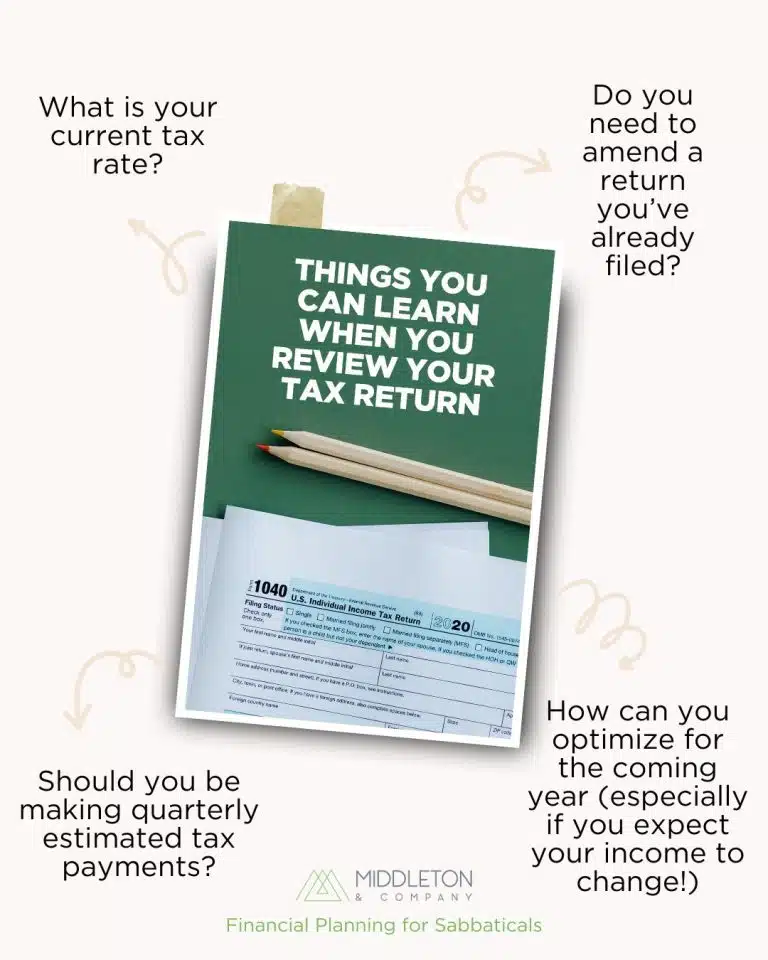
Table of Contents
Why Reviewing Last Year’s Return Is Worth It
Looking back helps you look forward. Here’s what a tax return can tell you:
- What is your current tax rate? How has your income changed over the last couple of years? Generally, your tax return will include a Two-Year Comparison Worksheet. It can help highlight your options for managing your taxable income going forward (and help you to understand the difference between your gross income, AGI, and taxable income!)
- Do you need to amend a return you’ve already filed? Have you found a mistake in your reporting? It’s okay, it happens. Filing an amended return could end up saving you money, or it can also clarify how information should be entered in future years.
- Should you be making quarterly estimated tax payments? Or should you just consider adjusting your tax withholding? Knowing if you had an underpayment penalty, got a big tax refund, or ended up owing as part of your tax filing can help you plan for how you want to pay your taxes throughout the year to avoid surprises.
- What opportunities do you have available to optimize for the coming year (especially if you expect your income to change!)
Understanding what’s showing up on your tax return is especially helpful if you’re planning a lifestyle shift, buying a new house, or changing your work situation.
Step-by-Step: What & How to Review Your Tax Return
AGI (Adjusted Gross Income)
📍 Found on Line 11 of your 1040 form
Your AGI is your total income minus certain deductions—like retirement contributions, HSA deposits, or student loan interest.
👉 Why it matters: AGI is used to determine your eligibility for many tax credits and deductions, both at the federal and state levels.
NOTE: You may be able to control this number even after the tax year has ended by making deductible IRA or HSA contributions before the April 15th deadline.
🛠 Check: Is your AGI equal to or lower than your gross income (line 9)? There may be opportunities here to explore.
MAGI (Modified Adjusted Gross Income)
MAGI starts with your AGI and adds back certain deductions to calculate your eligibility for specific credits and deductions.
The tricky part? There’s no single MAGI—there are multiple definitions with different calculations depending on what the MAGI is being used for.
👉 Why it matters: Your MAGI affects whether or not you qualify for things like:
- Lifetime Learning Credit
- American Opportunity Credit
- Child Tax Credit
- Deductible Traditional IRA or Roth IRA contributions
- Student loan interest deduction
- Affordable Care Act premium subsidies
- Net Investment Income Tax (not a credit or deduction, this is actually an additional tax)
🛠 Check: Did you qualify for all the credits or deductions you expected? If not, your MAGI might be the reason—and it’s worth understanding how it was calculated.
Marginal Tax Rate
Your marginal rate is the rate at which your last dollar of income was taxed. Because the U.S. has a progressive tax system, not all of your income is taxed at this rate—only the portion that falls within the highest bracket you reach.
👉 Why it matters: This rate can be influenced by strategic planning. For example, income deferral, retirement contributions, or your sources of income could impact which bracket you fall into.
NOTE: Your Capital Gains Tax Rate is separate from your Ordinary Income Marginal Tax Rate. Your combined total income will determine which bracket you fall into for each of these tax calculations.
Effective Tax Rate
This is your total federal tax liability divided by your taxable income. Because the tax system is progressive, your effective rate is always lower than your marginal rate.
👉 Why it matters: This number gives you a more accurate picture of your overall tax liability.
🛠 Check: How much of your income actually went to federal taxes? Comparing your effective rate year-over-year can show how your tax liability changes over time.
1040 Tax Return Line-by-Line: What to Look For
Line on Form 1040 | What to Look For |
Line 1: Wages | Ensure wages match your W-2 after your pre-tax payroll deductions like 401(k), 403(b), or HSA contributions. See a list of tax documents here. |
Line 2: Interest | Check to see how your tax-exempt interest (2a) compares to taxable interest (2b), especially if you’re in a higher tax bracket (24%+). Consider adjusting your investment portfolio for tax efficiency. |
Line 3: Dividends | Verify if your qualified dividends (3a) are a significant portion of your total dividends. Note that Line 3b reports your TOTAL dividends, including both ordinary and qualified dividends. The Form 1040 does not make this clear. Qualified dividends get the preferential capital gains tax rate; while ordinary dividends (Line 3b minus Line 3a) are subject to your ordinary income tax rate. Qualified dividends are more tax efficient than ordinary dividends. |
Line 4: IRA Distributions | Ensure amounts in 4a and 4b are correct, especially if you had any rollovers, Roth conversions, or Qualified Charitable Distributions (QCDs) during the tax year. In some cases, Line 4b should be less than Line 4a. where taxable distributions (b) should be less than the full distribution (a). Distributions from Inherited IRAs should also show up here. |
Line 7: Capital Gain | Long term and short term capital gains are netted out against each other using Schedule D. The final calculation will appear on this line of your 1040. If showing -$3,000, you may have extra capital losses, called carry forward losses. These can be used in future years to offset gains or up to $3,000 in ordinary income. Make sure to look over your Schedule D and keep track of those losses so you can use them in the future. |
Line 10: Adjustments to Income | This line is a summary of all adjustments found on your Schedule 1. Some adjustments include contributions to an HSA or IRA, rental or business income or loss, and a number of other income sources or special deductions. Review how these affect your taxable income and tax bracket. |
Line 11: AGI | Your Adjusted Gross Income (AGI) is the starting point for many tax credits, deductions and phaseouts, both at the federal and state level. |
Line 12: Deduction | Did you take the Itemized or Standard Deduction? Typically both are calculated and you take the higher of the two, unless you are subject to Alternative Minimum Tax (AMT). If you were close to the Standard Deduction, you could consider strategies like “bunching” charitable donations or property tax payments in certain years. |
Line 13: QBI Deduction | For business owners, review how the Qualified Business Income (QBI) Deduction applies, and plan accordingly to understand how to make the deduction work for you. You may want to review how your business is structured and how much you pay yourself in wages. Some real estate investments will also pass along a QBI deduction, including REITs. |
Line 15: Taxable Income | This is the income that is subject to tax. |
Line 23: Other Taxes | This line includes Self-Employment tax and the Net Investment Income Tax (NIIT). Review this line for potential tax planning opportunities if you’re a business owner or investor. |
Line 24: Total Tax | This is the total tax amount calculated from all forms and schedules. Ordinary Income Tax and Capital Gains Tax are calculated separately and added together in this line. |
Line 33: Total Payments | This is the amount of tax you have already paid during the year, either through withholding or estimated tax payments. |
Line 34: Refund | If you’ve overpaid throughout the year, this is the refund amount. Consider adjusting your tax withholding next year if you’re consistently getting large refunds. |
Line 37: Amount You Owe | If you have a balance due, review any one-time events that may have caused the larger tax bill, and consider adjusting withholding or estimated payments for the upcoming year. |
Line 38: Penalty | If applicable, you may owe a penalty for underpayment. It is possible to get a refund AND have an underpayment penalty. This is because the IRS wants the timing of your payments to line up with the timing of your income throughout the year. Consider increasing withholding or making estimated tax payments to avoid this in the future. |
Paid Preparer Section | Consider working with a professional tax preparer if you are a business owner, own investment property, are receiving equity compensation, or taking advantage of tax planning opportunities like backdoor Roth contributions, Roth conversions, or QCDs. |
Need help understanding your tax documents?
Tax Season Can Teach You About Your Finances And Be a Jumping Off Point for a Future Sabbatical >> Learn more here!
Review Your Tax Return: Takeaway
As you can see, your tax return holds a lot of important information—not just about the past, but also helpful data for this year and the future.
When it comes to taxes and financial planning, attention to detail is key. Small mistakes can lead to missed opportunities or unnecessary tax payments or bills.
Working with a professional can really help you here—not only to navigate the complexities of tax law, but also to keep track of your broader financial picture over time. And let’s not forget: a professional can provide peace of mind, making sure everything is accounted for.
But reviewing your tax return isn’t just about taxes; it’s about your bigger life goals! We view financial planning as a tool to help you live your best life. Whether you’re thinking about taking a sabbatical, switching careers, or simply being more intentional with your money, understanding where you stand gives you confidence and clarity.
As financial planners who specialize in helping people craft unique career paths and take sabbaticals, we understand how overwhelming this can all feel.
If you’re considering taking a sabbatical and could benefit from a thought partner, get in touch with us. We’d love to hear what’s on your mind and explore how we can best support you!
Like this article? Make sure to Pin It so you can go back to it later! 


KAILIE ABASCAL
Kailie is a Certified Financial Planner (CFP®) with a passion for helping clients navigate their financial strategies with creativity and confidence. Having lived in Cuba and Mexico, she brings a global perspective to her work, combining her diverse experiences with a deep understanding of financial goals. Kailie is dedicated to helping clients plan for sabbaticals and career breaks, ensuring these life changes are enriching without compromising long-term financial security.