
Dreaming of taking a career break but struggling to make it happen? You’re not alone.
Whether you’re thinking of traveling the world, spending more time with your family, or simply stepping away to slow down and reset, a sabbatical can be one of the most meaningful experiences of your life.
But when it comes to planning a sabbatical? That’s where most people get stuck.
As financial planners who specialize in sabbaticals (we’ve both taken one ourselves and are planning more in the future!), we get a lot of questions!
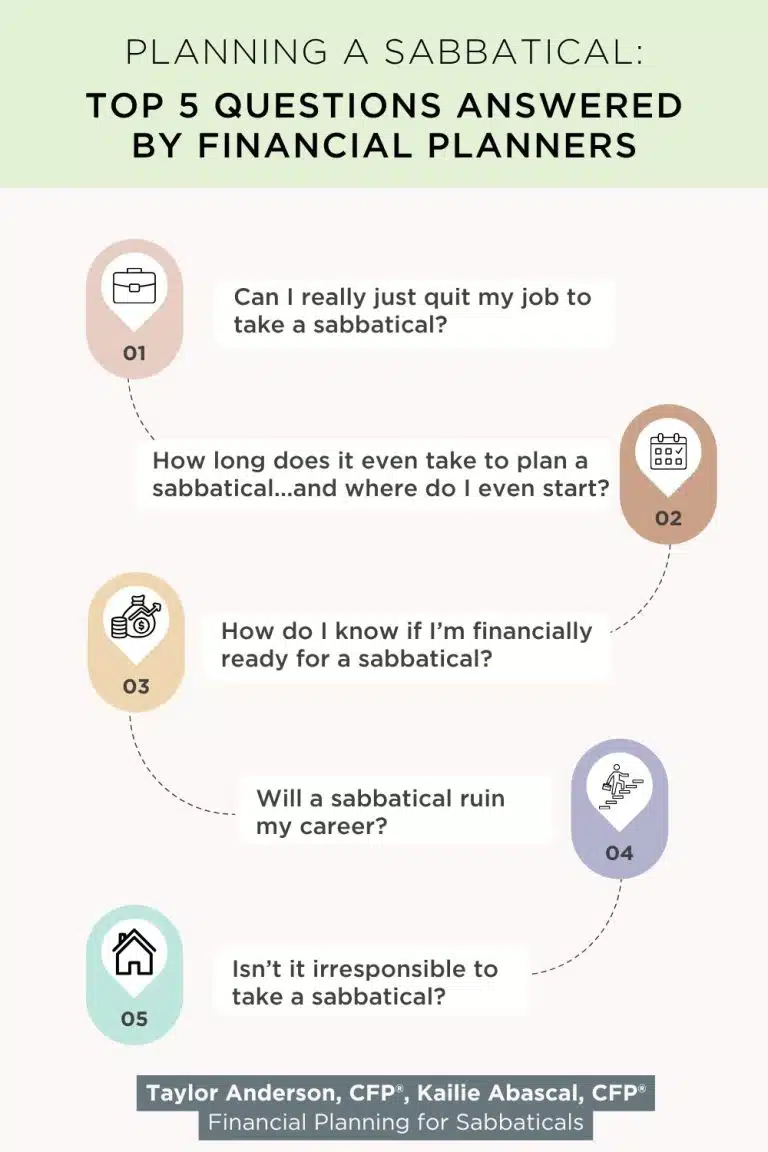
In this post, we’re answering the 5 most common questions we hear from people who wish they could take a sabbatical but are unsure about how to make it happen.
We hope this gives you clarity, direction, and encouragement to move forward with your plans!
“The best sabbatical isn’t about the perfect destination, the right timing, or a flawless itinerary. Your definition of ideal might change along the way anyway! What truly matters is that you take it. Too often, sabbaticals stay stuck in the ‘someday’ category. But if you feel a sabbatical could benefit you, we’re here to help you prioritize it, plan it, and make it happen, with peace of mind and the freedom to let yourself be transformed by the experience.”
Taylor Anderson, CFP®
Table of Contents

Question #1: Can I really just quit my job to take a sabbatical?
This is often the first and biggest mental hurdle. Quitting your job can feel like the ultimate risk as it challenges our ideas of security, identity, and success.
We’ve been conditioned to build our lives around work. But what happens when that work no longer aligns with who we are, what we value, or how we want to spend our time?
Taking a break isn’t reckless, it’s intentional. And with planning, it can be one of the most strategic career moves you make.
What we don’t realize is that by being stubbornly committed to our work, we miss out on opportunities to expand and grow, not only personally but also professionally.
So, first, try to understand why you think taking a career break is so risky:
- Are you afraid of running out of money? (More on that in Question #3.)
- Are you worried about finding a job afterward? (See Question #4.)
- Or is something else holding you back?
Question #2: How long does it take to plan a sabbatical…and where do I even start?
If your calendar is already packed with work deadlines, family obligations, and everyday chaos, how are you supposed to find time to plan a months-long or year-long break?
What do you do when you feel like you need a break to plan a break?
This is where many sabbatical dreams fade, not because they’re impossible, but because they get postponed. Life rarely slows down on its own.
Here’s the truth:
👉 You don’t need a perfect plan. You just need a starting point. 👈
Here are 3 things we recommend:
1. Start small, but start now
The most important first step is making the commitment: Decide now that you will take a sabbatical. Don’t worry yet about how or when.
From that mindset, ask yourself: What’s one small action I can take this month to get me closer?
Some ideas to get you started:
- Book a free initial consultation with us or a sabbatical coach
- Start researching one destination that excites you
- Create a work timeline with big projects or milestones you want to reach before going
Taking action, even a tiny one, builds momentum. It can bring some clarity and naturally leads you to the next small step.
2. Use time to your advantage
There’s no “perfect” time to plan a sabbatical, but the earlier you start your planning, the more options you’ll have.
In an ideal world, we suggest giving yourself at least two years for thoughtful financial and lifestyle planning. Some people start five or more years in advance, and that’s not too early either!
The more time you give yourself to plan allows you more freedom to design the experience you truly want. So as soon as you’ve committed to a sabbatical, start planning for it, even if it is a few years down the road!
If your timeline is shorter or uncertain – maybe you’re considering a break after a layoff or career pivot – there’s still plenty you can do. Planning is always valuable, no matter the timeline.
3. Delegate where you can
You don’t have to do it alone!
Working with someone who’s done it before can save you time, energy, and second-guessing.
And maybe most importantly, it provides essential accountability to make sure you don’t let your ‘normal life’ derail your sabbatical dream!
To figure what part of the planning to delegate out, play to your strengths. Be real with yourself about how much time and energy you have. Focus on what energizes you, and let trusted professionals handle the other stuff.
Some professionals you might consider hiring:
- Financial planner
- Sabbatical coach
- Travel planner/agent
- Credit card points specialists
We can help connect you with professionals who can do the work that you don’t want to do (but want to get done).
Question #3: How do I know if I’m financially ready for a sabbatical?
This is where things get real, and where a lot of people second-guess themselves.
You might be asking:
- “Do I need a specific number saved before I can even think about this?”
- “How do I balance this with retirement, kids’ college savings, or buying a home?”
- “What if I want to work less after my sabbatical?”
There’s no one-size-fits-all answer. But here’s what we do with clients:
- Assess your full financial picture as it is today – a “preflight check” if you will – to see what you have, and where money is going now
- Understand what you want your sabbatical to look and feel like, and get an idea of what you hope post-sabbatical life could be like
- Model different scenarios so you can see the impact of different decisions and timelines and move forward with your plan confidently
- Develop smart, tax-efficient savings strategies so you feel good about spending money while you’re away (no need to continually check account balances or move money around!)
- Track progress and keep you on course – we’ll monitor things leading up to your sabbatical, while you’re gone, and once you get back so that you don’t have to!
We’ll help you decide how much to save, what account to save it to, and how to make it work with your long-term goals, including retirement and beyond.
And if you’re planning for a low-income year during your sabbatical? We’ll also help you prepare for that! Learn more about tax strategies for a low-income year.
Question #4: Will a sabbatical ruin my career?
This is a very common fear we hear:
- “Will I be able to get hired again?”
- “Will future employers take me seriously?”
Here’s what we have seen over the years: a well-planned sabbatical can actually enhance your career.
By doing proactive financial planning leading up to your sabbatical, you know how long your financial runway is. It gives you time to find the next right thing for your career. You can be choosier about what the next position will be for you.
And time away, whether spent traveling, volunteering, studying, or slowing down, can give you a fresh perspective, increased resilience, and greater clarity about your goals and boundaries.
Employers increasingly value candidates who bring unique experiences, self-awareness, and intentional growth to the table.
We help clients thoughtfully frame their sabbatical in resumes and interviews so that your time away doesn’t look like a “gap”.
→ Check out how to talk about your past sabbatical during an interview.
And we are your partner in evaluating your job offers and overall compensation to help ensure your next step supports the post-sabbatical life that you imagined for yourself.
Question #5: Isn’t it irresponsible to take a sabbatical?
This is one of the most important and misunderstood financial questions we hear.
You might be thinking: “What if taking time off now jeopardizes my long-term financial security?”
We get it! As financial planners, we’re all about financial security. And the unknown can be really scary.
Your income might dip, your priorities may shift, and your idea of success probably includes more than just working until 65.
As financial planners who specialize in sabbaticals, we help you navigate both short-term and long-term goals. You don’t have to choose between taking a career break or building a secure future. Both are possible.
Here’s how we approach it:
- We build flexible, multi-scenario plans to show how your sabbatical fits into your broader financial picture. We can show you the best and worst case scenarios, and help you identify what’s in your control so you know where to focus your energy.
- We model tradeoffs: What happens if you take a year off at 40 and again at 46? What if you earn less after your sabbatical? What if you sell your house and rent for a while? What if you move states? What if your kids go to private school rather than public school?
You can see the impact of each of these decisions as they come up to help you navigate this crazy thing called life.
- We account for ebbs and flows of income, like career pivots, early semi-retirement, or starting a business after your break.
Online calculators have assumptions built into them – inflation rates, investment returns…but when you build out your own unique plan catered to what you want your life to look like – with breaks in income and all – you can more accurately reflect what real life looks like for you.
- We design your savings strategy accordingly, choosing the right accounts and investment mix to support your goals, both immediate and long-term.
Don’t wait for retirement to take a break! You can create space for meaning, growth, and rest as an integral part of your career.
What would it take to make your sabbatical happen? Don’t talk yourself out of the idea. Instead, commit to it!
Our job is to help you discover what’s possible, build a roadmap to get there, and support you every step of the way, financially, emotionally, and logistically.
You don’t have to do this alone.
If you’ve got more questions (or if you’re ready to get started), we’re here to help you make your sabbatical dream a reality.
→ Get in touch with us
→ Check out how we can support you before, during, and after your sabbatical!
We’re so excited that you’ve decided to at least explore the idea of going on a sabbatical. We wouldn’t be here if we weren’t convinced this is an amazing opportunity! We hope these answers help you feel a little more prepared and confident about the idea of taking a sabbatical.
We hope we’ve answered your top questions regarding sabbatical planning. If we didn’t answer one of your questions, send it to us at clientservices@middletonand.co, we’d love to help!
If you’re ready to take the next step in pursuing your dream, contact us today. We offer individualized support with smart financial and sabbatical planning made for you, your dream, and your unique situation!
Click here to schedule a discovery call now.
Like this article? Make sure to Pin It so you can go back to it later! 



taylor anderson
Taylor is a Certified Financial Planner (CFP®) with a knack for making complex concepts simple and visual. After taking a two-and-a-half-year sabbatical to join the Peace Corps and travel Southeast Asia, she now satisfies her travel itch by exploring the Northwest in her Sprinter van with her two boys. When she's not helping clients with financial planning, you'll find her backcountry skiing with her husband and Australian Shepherd.